
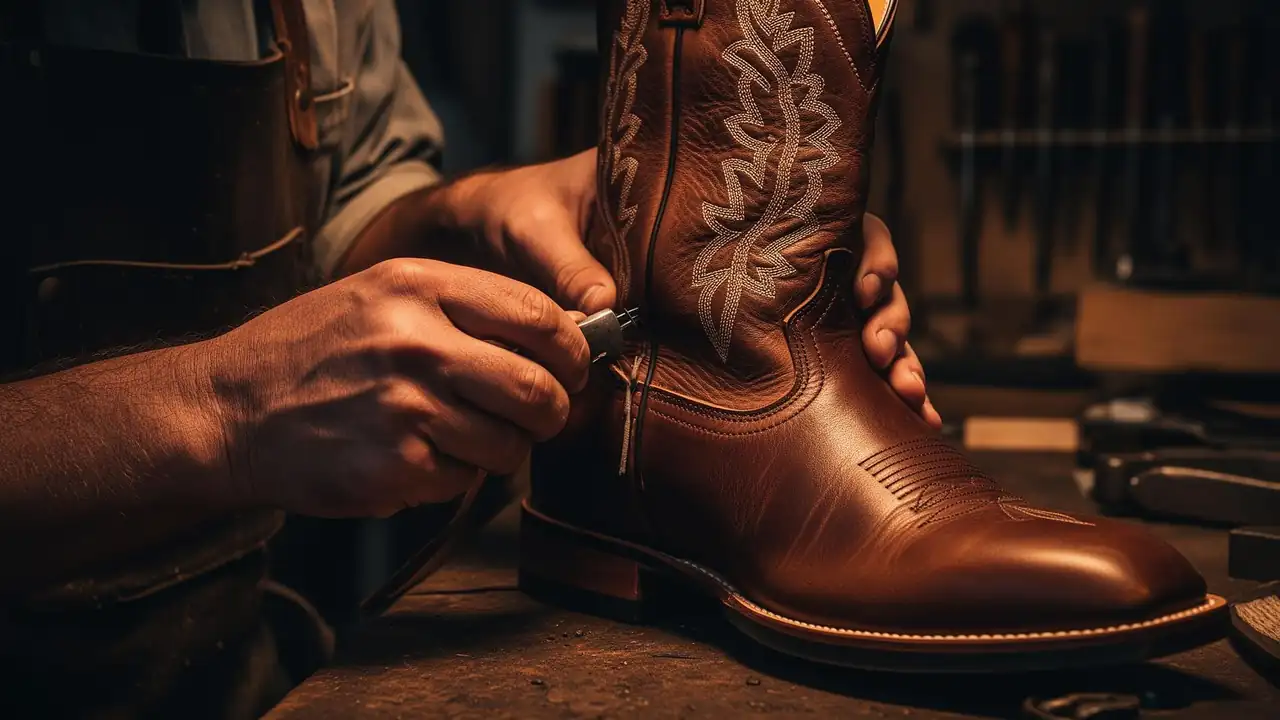
A private label boot brand sells boots designed for it and made by a manufacturer, with the brand's own name on the product. You own the brand, the customer relationship and the collection decisions. The factory brings the lasts, patterns, machinery, materials sourcing and skilled people needed to build the boot. This guide walks through the decisions that matter most, in the order you will face them, so your first conversation with a factory is productive.
1. Decide who the boot is for
Before choosing leathers or toe shapes, write down who will buy the boot and where. A western boot sold in a Texas retail store, a work-ready boot for a ranch supply catalog and a chelsea boot for a city boutique are very different products, even if they share the same construction. Be specific about:
- Your customer: what they wear the boot for, and what they compare it to today.
- Your channel: your own online store, wholesale to retailers, a distributor network, or a mix.
- Your market: the countries you sell in, because they shape size runs, labeling and how you import.
This short brief will guide every later decision and lets a manufacturer tell you quickly whether the product fits what they make.
2. Choose your product line
Start with a focused collection. Most new brands do better with a few well-chosen styles in a small number of colors than with a wide range that spreads quantities thin. At OAK we manufacture three Goodyear welt lines: western boots, western work boots and chelsea boots. Many brands begin with one line and add the others once the first styles sell through.
3. Pick a development path: platform or special development
This is the biggest decision for timing and budget, and it is worth understanding before you request a quote.
Build on existing platforms
A platform is a base boot the factory already makes: an established last, pattern and construction. You customize it with your choice of leathers, colors, stitching and branding. At OAK, platform customization is available within the OAK Platform Catalog. This path usually suits a first collection, because the core of the boot is already proven and you focus on what makes it yours.
Special development
If your design needs a new shape, last, pattern or tooling, it becomes a special development project. You get a boot that is truly your own, but samples, engineering and tooling are quoted separately, and the process involves more rounds of review. It suits brands with a clear design that no existing platform can deliver.
A sensible approach is to launch on platforms, learn what your customers buy, and invest in special development for the styles that prove themselves.
4. Choose the construction
Construction decides how the sole is attached to the upper, and it shapes how your boot is positioned. In a Goodyear welt boot, the outsole is stitched to a welt rather than only bonded with adhesive, and a qualified repair specialist can replace the outsole when it wears down. That gives a premium brand a clear, honest story: a boot made to be resoled. If you are weighing the options, our guide to Goodyear welt vs cemented boots explains the trade-offs.
5. Prepare the information a factory needs
An accurate quote depends on accurate inputs. Before you contact a manufacturer, prepare:
- Your brand name and website, or a short description if the brand is new.
- The product type and development path (platform or special development).
- Leathers and colors, including any exotic leathers you are considering.
- Your size run.
- Pairs per model and per color.
- Your target market and target delivery date.
- Reference photos or sketches, if you have them.
Quantities per model and per color matter more than a single total, because each color and style is produced separately. If you are unsure, give a realistic range and say so.
6. Understand quotes, minimums and samples
Every factory works differently, so ask early how pricing, minimums and samples work. At OAK, initial quotations are in USD, EXW OAK Footwear León, and are subject to validation. For platform programs, final pricing is confirmed after the sample is completed; for exotic programs, after species and material validation. Minimums and lead times depend on the program and are confirmed with your quote. Samples are quoted separately and paid before work begins.
If your first order is smaller than private label minimums, you still have options. Our own brand ITO offers boots from its special collections starting from a single pair, with special wholesale pricing from 12 pairs. See wholesale western boots for how the two routes compare.
7. Approve the sample carefully
The approved sample becomes the reference for production, so review it thoroughly. Check fit across the size run you plan to sell, leather color and finish, stitching, branding placement and packaging details. Write your comments down clearly and keep a photo record. Changes are far easier to make at the sample stage than after production is scheduled. At OAK, production is scheduled only after final sample approval, receipt of the down payment and validation of applicable documentation.
8. Plan shipping and import
Know how the boots will reach you before you place the order. With EXW pricing, your freight forwarder or customs broker arranges pickup, freight, duties, insurance and import into your market. Talk to a forwarder early: they can advise on documents, labeling and timing for your country. OAK's sales team and showroom office in Houston, Texas, also support buyers with logistics and service.
9. Think in programs, not one-off orders
The strongest private label brands build recurring programs: core styles that are reordered season after season, with new styles added over time. Reorders of previously produced styles with identical colors and specifications are evaluated individually and can be simpler than a new development. Choosing a manufacturer you can grow with is as important as the first order; our guide on how to choose a boot manufacturer covers what to look for.
A simple launch checklist
- Write a one-page brief: customer, channel, market.
- Pick one product line and a focused set of styles and colors.
- Decide between platforms and special development.
- Choose the construction and how you will explain it to customers.
- Prepare quantities per model and per color, size run and target date.
- Request a quote and ask how minimums, samples and pricing validation work.
- Review and approve the sample in writing.
- Line up your forwarder and plan import before production ends.
We work with established brands and with new brands that are just starting out, especially those looking for a long-term relationship. When your brief is ready, see how our program works and send us your project using the form below.